Mademoiselle Pogany: Beyond Likeness
Brâncuși’s portrait of a fellow artist grew from sittings, destroyed studies and recollection. Its enormous eyes still ask what makes a face recognisable.
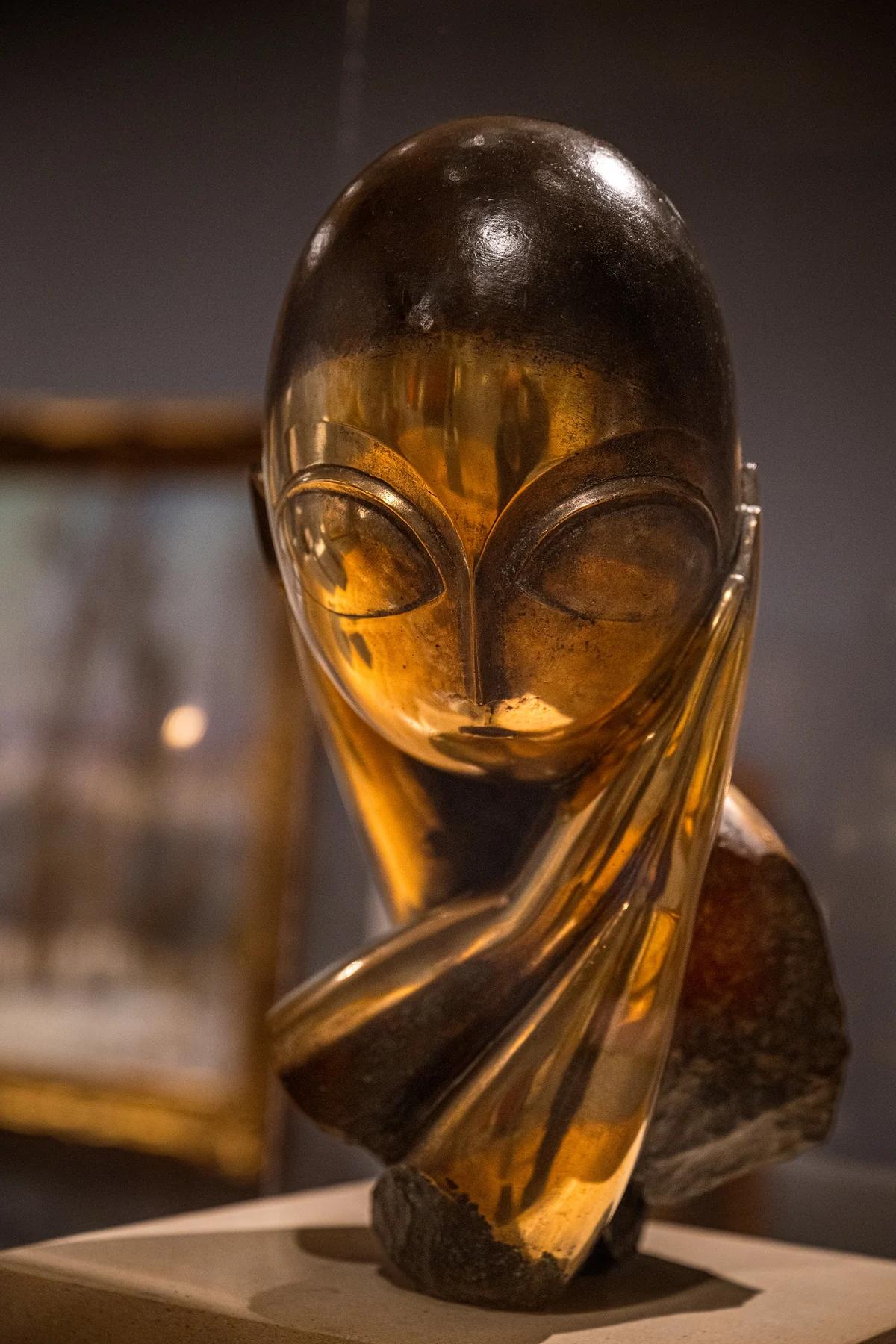
The eyes make the first claim on attention. They occupy so much of the face that everything around them seems to gather in response: the curved forehead, the narrow nose, the hands rising towards the head. Mademoiselle Pogany turns the act of looking into its subject. Yet behind this extraordinary face was a particular person, with an artistic life of her own.
A painter remembered
Margit Pogany was a Hungarian artist studying painting in Paris when she sat for Brâncuși in 1910 and 1911. MoMA’s account records an unusual sequence: after she returned to Hungary, he carved her portrait in marble from memory, then made a plaster mould for bronze versions. The museum’s bronze dates to 1913, following the marble of 1912. 1
Memory had followed a sustained effort to work from life. The Centre Pompidou describes clay studies made during the sittings and destroyed because Brâncuși remained dissatisfied. That history makes the eventual economy of the portrait particularly absorbing. Its apparent ease came after repeated attempts. Distance from the sitter became part of the making. 2
It is tempting to imagine recollection as a loss of information. Here it can be understood as an ordering of attention: some features persist with unusual force, while others become less insistent. The finished face gives those remembered emphases a physical structure.
The architecture of a face
The Centre Pompidou follows a continuous movement through the sculpture, from the hands into the neck and skull. The prominent eyes and projecting nose belong to this larger arrangement. Looking along that route changes how the portrait can be read. Each feature participates in a rhythm that extends beyond its own outline. The head feels held together by the movement of the whole. 2
Material supplies further distinctions. In MoMA’s bronze, a dark patina marks the hair across the crown and the elaborate chignon behind the neck. The face’s smooth oval and the immense eyes remain emphatic, but the contrast of surfaces gives the head another register. The back deserves as much attention as the front: a portrait encountered in the round unfolds over time. 1
The work caused considerable argument when it appeared in Brâncuși’s early American exhibitions, including the 1913 Armory Show. The Philadelphia catalogue essay preserved by French Sculpture records critics’ preoccupation with the eyes, nose and coiffure. Features that now seem central to the sculpture’s character were precisely those that unsettled its first viewers. 3
The sitter’s place in the story
Pogany’s own painted self-portrait and surviving photographs offer another route back to her. The Philadelphia catalogue points to the distinctive eyes and carefully arranged hair visible in those images. These comparisons give the sculpture’s departures a personal context. There was an observed face behind the formal invention. 3
Decades later, Pogany herself helped determine where one version would be seen. MoMA’s 1953 acquisition notes describe a letter from her in Australia offering the bronze portrait to a museum; the ensuing purchase brought it to New York. The sitter thus reappears in the work’s history as its owner and correspondent. 4
That detail sharpens the encounter. The sculpture has become an emblem of modern portraiture, but its title continues to name someone. Its strange, concentrated presence leaves room for both the artist’s transformations and the person who occasioned them.