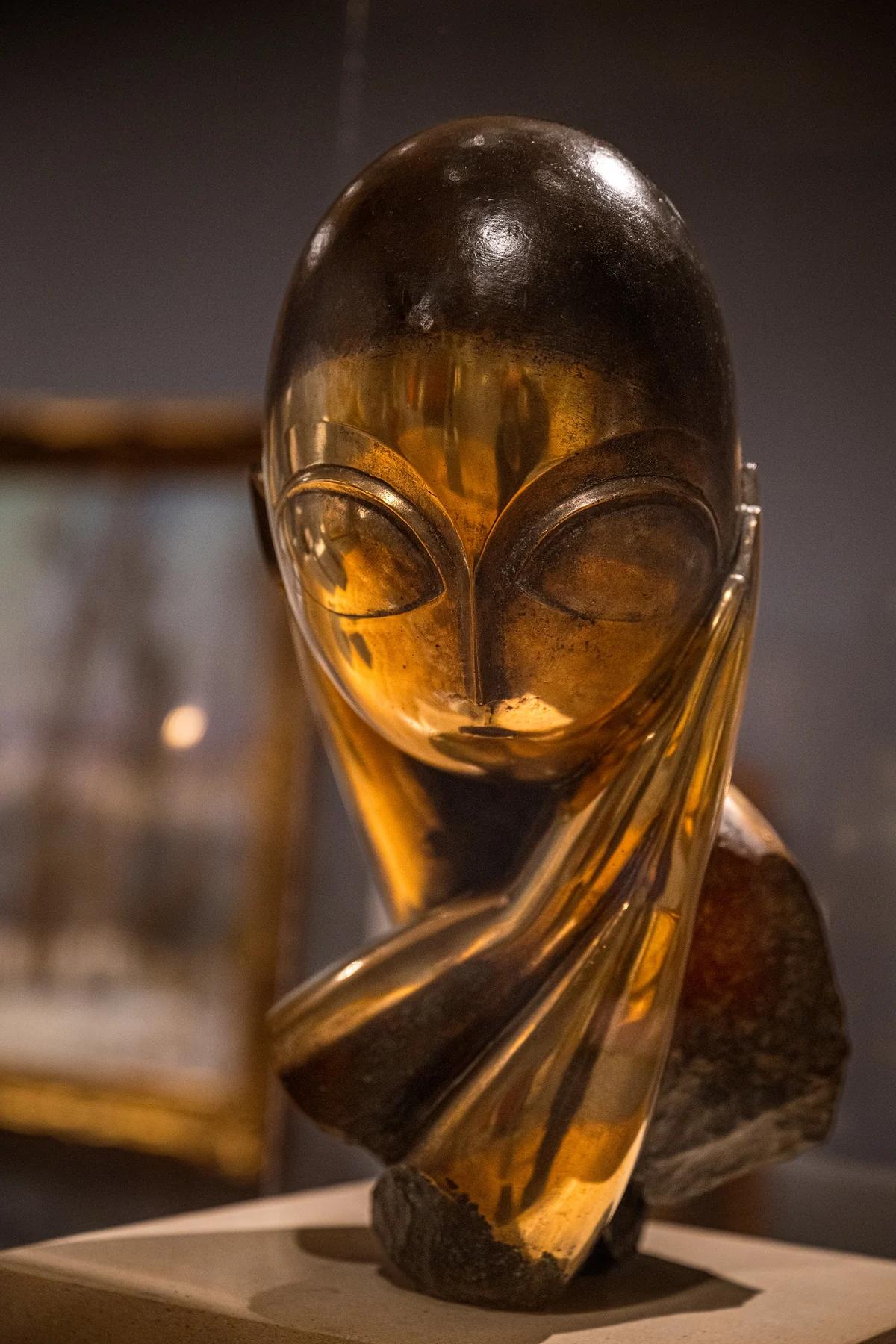
Măiastra: From Fairy Tale to Flight
A bird from Romanian folklore gave Brâncuși a subject he could keep changing. Its journey into Bird in Space reveals how much a sculpture can carry as its outline grows simpler.
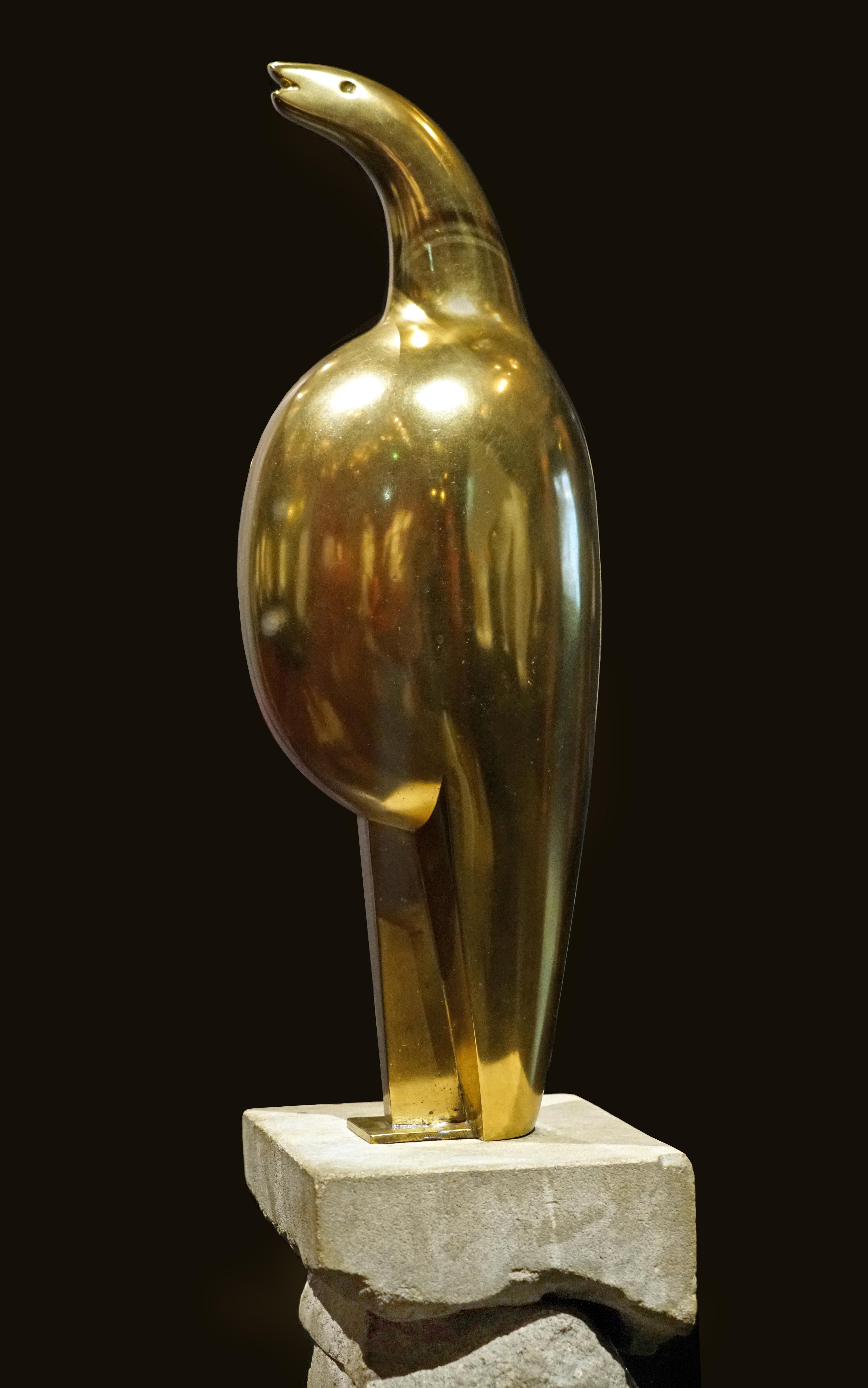
A raised head, a swelling breast, an open beak: Brâncuși’s early Măiastra holds the moment before a sound. Its stillness has expectancy. Looking at this compact creature beside the long, ascending shape of Bird in Space, it becomes possible to follow an idea through changes of body, material and scale.
A bird with a voice
Măiastra belongs to Romanian folklore, where a marvellous bird possesses brilliant plumage and a restorative song. Brâncuși began working on bird forms around 1910. In the version dated about 1912 at the Peggy Guggenheim Collection, the polished brass surface carries some of the legend’s radiance. The chest expands beneath an arched neck; a sharply cut limestone support makes the creature appear to perch. The museum’s account connects this pose to the possibility of singing. 1
That connection offers a useful way into the sculpture. A viewer can imagine breath gathering inside the rounded body and passing upwards towards the beak. The bird’s power is concentrated in a few relations: fullness and narrowness, curved metal and angular stone, an apparently living creature and the support beneath it.
The changing outline
The National Gallery of Art places Măiastra at the beginning of a sequence that passes through Golden Bird towards Bird in Space. These are related sculptural series, with changes within each group as well as between them. The gallery’s Măiastra, dated about 1911, retains a recognisable body and lifted head. Its account draws attention to the slight turn of the head and the precise meeting of curved and angular forms. 2
The sequence invites close comparison. Where does the chest reach its greatest width? How quickly does the neck narrow? How much of a head remains? Such questions make abstraction tangible. Altering one contour can change a bird’s bearing, its apparent weight or the direction in which it seems ready to move. The surviving works allow the subject to be encountered repeatedly, with a different answer on each occasion.
Seen this way, the earlier birds retain their own completeness. Their compact bodies give particular force to the upward gesture. A later, more elongated silhouette asks the eye to travel farther.
The room enters the sculpture
By the National Gallery’s Bird in Space of 1927, the familiar anatomy has given way to a tall form that broadens gently and then tapers. The museum identifies its materials as brass, limestone and wood. The transition between them matters: the lifted metal form belongs to an arrangement that continues down through differently shaped supports. The gallery’s audio commentary treats those supports as part of the sculptural experience. 3
Light adds another kind of movement. The polished surface catches the room and the people around it, so that an apparently self-contained shape becomes visually unstable. A small change in the viewer’s position brings a different reflection. The sculpture stays still while its appearance keeps moving.
One way to read the journey from Măiastra is as an increasing demand on the imagination. First a beak suggests a song; later an ascending line suggests flight. The viewer supplies what stone and metal cannot literally perform. The fairy-tale bird survives through that invitation to imagine an action beyond the object’s physical limits.
Sources & further reading
- 01Peggy Guggenheim Collection — Maiastra, ca. 1912
- 02National Gallery of Art — Maiastra, c. 1911
- 03National Gallery of Art — Bird in Space, 1927
Image: Tate Măiastra · Photo: Jean-Pierre Dalbéra · CC BY 2.0.